finance, investments, Picks

Strip Bonds —– How Risqué are they?

Bonds in which the coupons have been detached from the bond itself, leaving only the maturity (principal or residual) amount at the maturity date are called “Strip”, “Zero-Coupon” or Residual Bonds. We will call the strip coupons also strip bonds and refer to the due date of the coupon as also the maturity date. The striped bond maturity amount and the coupons trade separately.

The interest on your purchase price accumulates year by year and your purchase price plus accumulated interest is paid in total at the maturity date of the bonds. These bonds are also referred to as compound interest bonds. In between the purchase date and maturity date the strip bonds may trade in the market at discounts or premiums.  Of course, if you hold the strip bond to the maturity date then what happens in between these two dates does not affect your rate of return which can be calculated when you purchase the bond. Hence in the case when you purchase government, government backed or equivalent, Strip bonds are extremely secure and stable.

However, should you need to sell your strip bond before maturity you may find that the market price may deviate substantially from your purchase price plus accumulated interest calculated. This is because as interest rates rise people expect a higher return on their investment. This can only be accomplished by the market value of bonds dropping and hence resulting in higher returns. Conversely when interest rates drop, the market price of bonds usually rises because buyers are satisfied with a lower return than previously. Thus strip bonds can be very volatile especially when interest rates are changing.

The interest earned on a strip bond, according to Revenue Canada must be reported year by year as ordinary interest income. Below is an example of a Strip Bond whose quotation was found on TDWaterhouse. The bond is issued by the Province of Ontario and we are told that you can purchase $100 face value or principal amount of this bond for $75.787 and receive the maturity value of $100 on January 13 2024. We will assume the bond is actually paid for on October 1 2014. The quotation also tells us that we will earn a rate of 3.01623% per annum compounded half yearly if bought for $75.787.

Issuer Full Name Currency Maturity Offer Qty Bid Yield Bid Price Ask Price Ask Yield Type Rating
PROVINCE OF ONTARIO CAD 01/13/2024 7,727 3.30705 73.804 75.787 3.01623 STRIP COUPON BOND AAl
From to number of days
October-01-14 January-13-15 104
Interest on $75.787 from to 75.7878*i*104/365=
October-01-14 January-13-15 .28493*i
From to number of years
January-13-15 January-13-24 9

We set up the above table which tells us that that $75.787 invested on Oct. 1 2014 for 9.28493 years will give us $100 on Jan. 13 2024 (and nothing else).

If we weren’t given the rate of return we could find it as follows:

The yearly effective interest rate per year earned on this investment. Using the compound interest formula (you may ignore this), we obtain 75.787*(1+i)^9.284932 =100. Then i =(100/75.787)^(1/9.28493)-1 =.0303 or 3.03%

Let k be the equivalent rate per annum compounded half yearly. Using excel (which you can ignore) we solve for k.

1.0303=(1+k/2)^2, k= 2*(SQRT(1.0303)-1 = .0301 or 3.01% per annum compounded half yearly. Any difference between the quoted rate and our rate is due to the uncertainty on the settlement date, rounding and a slightly different method used.

We shall use the rate 3.03% effective yearly to form the table below showing how the $75.787 grows to $100 by compounding year by year

using i=.0303
Date Principal Interest
October-01-14 75.7870
January-13-15 76.4413 75.787*.0303*.2849= 0.6543
January-13-16 78.7575 76.4413*.0303= 2.3162
January-13-17 81.1438 78.7575*.0303= 2.3864
January-13-18 83.6025 81.1438*.0303= 2.4587
January-13-19 86.1356 83.6025*.0303= 2.5332
January-13-20 88.7455 86.1356*.0303= 2.6099
January-13-21 91.4345 88.7455*.0303= 2.6890
January-13-22 94.2050 91.4345*.0303= 2.7705
January-13-23 97.0594 94.2050*.0303= 2.8544
January-13-24 100.0003 97.0594*.0303= 2.9409
Note that according to Canada Revenue the yearly interest earned must be declared as ordinary income year by year if bought outside a registered plan..
Your brokerage firm will supply you with these interest payments (which in this case may differ slightly then those in the table above)

As was said before, if you wanted to sell the bond before maturity date the price can vary a great deal . For example, If you wanted to sell your bond on January 13 2019 and interest rates were at 6% per annum you would receive approximately $74.73. If rates were at 2% per annum you would receive approximately $90.57.

Guaranteed Investments —-You Cannot Lose!

You have all seen ads to the effect that for certain structured investments your principal amount will be guaranteed to be paid at the end of a fixed period regardless of how the markets perform but your profits are unlimited. That is, you might end up not making any money but have the comfort of knowing that you cannot lose any money. Sounds too good to be true? Well, suppose we construct such a situation. We will use Strip Bonds as described below.

Using the previous example you can set up such an investment on your own. You are going to invest, say $100, on Oct. 1 2014 and you will terminate your investment on January 1 2024. Invest $75.79 in the strip bond described above. This guarantees that your initial investment of $100 is returned to you on Jan. 1 2024. Also use the remainder of your $100 investment i.e., 100 – 75.79 = $24.21 to invest in stocks or any other securities. Even if this investment of $24.21 is a complete flop and it dwindles to $0, on Jan. 1 2024 your $100 will be returned to you via the Strip bond.

On the other hand, if your investment of $24.21 resulted in an accumulated doubling to $48.42 on Jan. 1 2024, you will have earned a return of 4.345% per annum compounded yearly.

This kind of structured investment is best done in a registered plan such as an RRSP or RESP since there will be no tax consequences until the plan matures. If done outside a registered plan you would probably have to pay tax every year on the interest earned by the strip bond.

Standard
finance, investments, Picks

Split Shares of TD Bank

Unknown

TDb Split Corp. is closed-end mutual fund consisting of units invested in the common shares of TD Bank. These units are divided or split into two classes of shares, one kind is the Class A Shares while the other is the Priority Equity or Preferred Shares. The various shares trade separately on the TSX under the symbol XTD for the Class A shares and XTD.PR.A for the preferred shares.

As stated by the company, its investment objectives with respect to the Priority Equity Shares are:

(a) to provide holders of the Priority Equity Shares with fixed cumulative preferential monthly cash dividends in the amount of $0.04375 per Priority Equity Share to yield 5.25% per annum on the original issue price of $10; ]

and

(b) on or about December 1, 2019, to pay the holders of the Priority Equity Shares the original issue price of $10 for equity shares.

With respect to the Class A Shares, the objectives are:

(a) to provide holders of Class A Shares with regular monthly cash dividends targeted to be $0.05 per Class A Share to yield 6.0% per annum on the original issue price of $10;

and

(b) on or about the December 1, 2019, to pay the holders of Class A Shares at least the original issue price of the Class A Shares.

Under certain conditions, the termination date of December 1, 2019 may be changed to a later date. Only after the holders of the Priority Equity Shares receive the distribution of $0.5250 on their shares will the class A shareholders receive distributions, if available, from the total fund and subject to other restrictions.

The net asset value of a class A share is the net asset value of a unit minus the fixed net asset value of a Priority Equity Share which stays fixed at $10. This means that the class A shares reflect the increasing or decreasing market value of the underlying TD Bank shares. For example, if the net asset value of a unit is $15 at then the net asset value of a class A share would be $5.

The closing prices on the TSE today, October 1 2014 were:

Class A shares (XTD),   $5.22 with a distribution of $0.60 for a yearly yield of 11.49%;

Priority Equity Share (XTD.PR.A),   $10.17 with a distribution of $0.525 for a yearly yield of 5.16% .

The Net Asset Value of a unit on September 15 2014 was $15.60

The fund is managed by Quadravest Capital Management . For more information please go to its website at http://www.quadravest.com . For those people interested in TD Bank you may also want to follow XTD and XTD.PR.A.

-M

Standard
Picks

Citadel Income Fund (CTF), A Closer Look.

The following was written originally written on June 1, 2014 and updated September 26, 2014.

logo

Citadel Income Fund (CTF.UN) is an example of a “closed – fund“ managed by Artemis Investment Management. Think of it as a company whose main assets are securities such as stocks and bonds each of which can be bought or sold on securities or stock markets. On any given day one can find the total Net Asset Value (NAV) of the fund by adding up the market values of all the shares at the prices that they trade at plus any other assets less any liabilities. On December 31 2013 the total NAV of CTF.UN was $113,494,197. The actual ownership of CTF.UN was represented by the 25,041,625 shares (units) into which the company is divided.

Accordingly, each unit had a NAV of $113,494,197 divided by 25,041,625 equaling $4.53 NAV per unit. You would expect that if CTF.UN was terminated on December 31 2013 a person owning some units of CTF.UN would receive a total of $4.53x(the number of units owned)

One would imagine that on a given date, December 31 2013 for example, the units could be bought or sold at approximately $4.53 per unit, as would be the case of an “open-ended” fund. In an open-ended fund, the managers can issue or cancel units to assure within a degree of approximation that the units can be bought or sold (redeemed) at the NAV. However CTF.UN is a closed-end fund which means units are bought and sold between investors at prices already agreed upon. There are no new units issued or cancelled ensuring the NAV per unit is the market price.

This means that the market price of the units can be equal to the NAV per unit, or they can be below the NAV per unit (we say the units are trading at a discount) or in another instance, they could trade at a price above the NAV (we say the units are trading at a premium).

On December 31 2013 units of CTF.UN were trading at the discount price of $3.74, i.e. a discount of 17.44%. On the manager’s Website (see below) we find the following brief history of the NAVs and market prices of CTF.UN:


Citadel Income Fund – NAV and Market Price History


Date Net Asset Value Market Price Premium (Discount)
30-May-2014 $4.65  $3.34  (28.17)% 
23-May-2014 $4.70  $3.32  (29.36)% 
16-May-2014 $4.67  $3.33  (28.69)% 
09-May-2014 $4.67  $3.30  (29.34)% 
02-May-2014 $4.72  $3.34  (29.24)% 
25-Apr-2014 $4.68  $3.32  (29.06)% 
17-Apr-2014 $4.69  $3.29  (29.85)% 
11-Apr-2014 $4.61  $3.28  (28.85)% 
04-Apr-2014 $4.66  $3.26  (30.04)% 
28-Mar-2014 $4.63  $3.23  (30.24)% 
21-Mar-2014 $4.62  $3.24  (29.87)% 
14-Mar-2014 $4.55  $3.20  (29.67)% 
07-Mar-2014 $4.59  $3.25  (29.19)% 
28-Feb-2014 $4.58  $3.31  (27.73)% 
21-Feb-2014 $4.59  $3.35  (27.02)% 
14-Feb-2014 $4.56  $3.35  (26.54)% 
07-Feb-2014 $4.50  $3.30  (27.00)% 
31-Jan-2014 $4.47  $3.24  (27.52)% 
24-Jan-2014 $4.51  $3.45  (23.50)% 
17-Jan-2014 $4.58  $3.69  (19.43)% 
10-Jan-2014 $4.55  $3.68  (19.12)% 
03-Jan-2014 $4.49  $3.67  (18.26)% 
27-Dec-2013 $4.56  $3.68  (19.30)% 
20-Dec-2013 $4.48  $3.68  (17.86)% 
13-Dec-2013 $4.38  $3.55  (18.95)% 
06-Dec-2013 $4.45  $3.58  (19.55)% 

Currently CTF.UN pays out a dividend or distribution of $0.01 per month and trades at a discount of approximately 28%

Citadel Income Fund

Top 25 Securities As of March 31, 2014 By % of Total Assets


  1. TORONTO DOMINION BANK 5.27
  2. ROYAL BANK OF CANADA 4.85
  3. BANK NOVA SCOTIA 4.03
  4. CANADIAN IMPERIAL BANK OF COMMERCE 3.26
  5. POTASH CORP OF SASKATCHEWAN INC 2.52
  6. CDN NATURAL RESOURCES LIMITED 2.42
  7. THOMSON REUTERS CORPORATION 2.40
  8. CANADIAN NATIONAL RAILWAY COMPANY 2.31
  9. CASH 2.29
  10. MANULIFE FINANCIAL CORP 2.23
  11. MAJOR DRILLING GROUP INTERNATIONAL INC 2.22
  12. CANADIAN IMPERIAL BANK OF COMMERCE CORP 2.14
  13. ROYAL DUTCH SHELL PLC 2.14
  14. CATERPILLAR INC 2.10
  15. ENCANA CORPORATION 2.08
  16. JOHNSON & JOHNSON 2.06
  17. TECK RESOURCES LTD 2.04
  18. CLIFFS NATURAL RESOURCES INC 1.93
  19. PFIZER INC 1.91
  20. INTER PIPELINE LIMITED 1.87
  21. BCE INC 1.85
  22. HSBC HOLDINGS PLC 1.77
  23. PEPSICO INC 1.76
  24. TOTAL SA 1.68
  25. TRANSCANADA CORPORATION 1.66

For more details on CTF.UN please go to the web page of the managers, Artemis Investment Managers at; http://artemis.mobilelinkage.com/nav_info.php?id=30

Units of CTF.UN are currently trading at approximately 28% below the net asset value with a 3.6% distribution. Purchase of the units should be considered as a conservative investment as there is anticipation that the discount to NAV would gradually lessen. Further, in such situations where the market price is substantially below the NAV, a large number of very dissatisfied investors holding units of CTF.UN may force the management of CTF to actually terminate the fund, resulting in unit holders obtaining the NAV of the units and realizing a large premium above the current market price. The declaration of Trust does provide legal recourse in how this can be pursued. This however, is a discussion for another instance.

-M


Standard
Picks

Is Power Corp. a Blue Chip Stock?

POWER CORP CDA  (POW) and POWER FINANCIAL (PWF)

logo_en

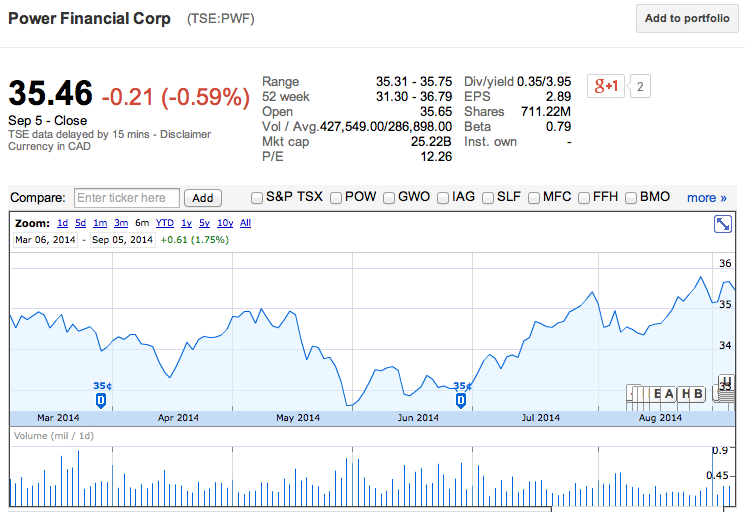
POWER CORP CDA  (POW) and POWER FINANCIAL (PWF) recently traded at $32.47 and $35.67 respectively on the Toronto Stock Exchange, not far above their lows for the last 12 months. Both of these companies are of high quality, low risk “blue chip “ investments providing dividends close to 4% at current market prices. Power Corporation is a holding company, owning a major share of Power Financial.

Some management background:

Power Corporation holds interests, directly or indirectly, in companies that are active in the financial services, communications and other business sectors. In particular, Great-West Life (GWO), IGM Financial (TSX:IGM) and Power Financial Corp. (TSX:PWF) are all part of Power Corporation. Further, Power Corporation’s Gesca subsidiary is one-third owner of The Canadian Press.

Screen Shot 2014-09-06 at 1.37.49 PM

While Power Corporation’s financial performance these past months has been extremely disappointing the outlook appears to be promising. In particular, with anticipated higher interest rates, the earnings of Great West Life should show significant improvement.. A dividend increase in the following 12 months for both Power and Power Financial would not surprise people.

As a conservative low risk investment, both Power And Power Financial should be of interest.

-M

Standard